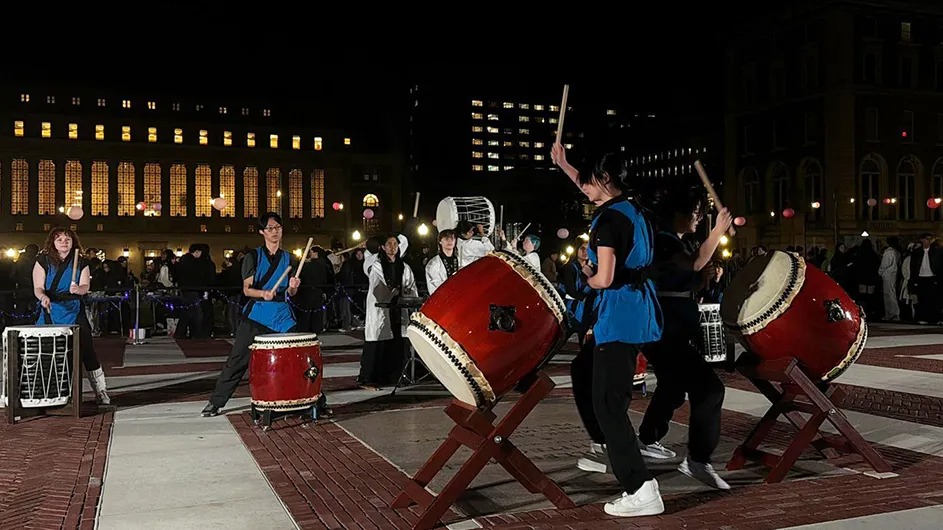
On Sunday afternoons, the upper floors of Columbia University’s Lerner Hall fill with the deep, rolling sound of Japanese drums. Columbia Taiko, a student ensemble devoted to the centuries-old art of taiko drumming, opens its weekly rehearsals to anyone with a Columbia ID – no audition and no musical background required.
For newcomers, the first lesson has nothing to do with rhythm. Before they ever strike a drum, beginners are taught how to stand: where to plant their feet, how to grip the sticks and how to drive each hit with the whole body. Only then do they learn to land those hits in sync with the rest of the group.
Co-president Tam Serber said the early sessions focus heavily on correcting form, so new members do not pick up habits that are hard to unlearn later. Beginners then work through a simple practice piece that covers every basic type of strike while teaching them to follow the tempo and play as one unit with the ensemble. The goal, Serber said, is for newcomers to start “playing cohesively in a group.”
A decade of drumming on campus
Founded in 2014, Columbia Taiko – also known as CU Taiko – was created to promote traditional Japanese drumming within the Columbia community and to introduce the art form to audiences across New York City. Today the club counts about 30 members.
The word taiko simply means “drum” in Japanese. The tradition grew out of religious ceremonies and village festivals in Japan and has since evolved into a performance art practiced throughout North America. The Columbia group plays both traditional and contemporary works under the guidance of instructor Yoko Nakahashi, who also teaches members about the history behind the pieces they perform.
Rehearsals and performances
Open practices run every Sunday from 1 to 4 p.m., usually in Room 477 or 478 of Lerner Hall. Sessions start with a group greeting, stretching and a warmup, and members rotate on and off the drums so that everyone gets playing time. Performing members commit to at least two practices a week, with extra rehearsals held on Tuesday, Thursday and Friday evenings.
The ensemble appears at campus events such as Night Market and Matsuri, stages an annual spring showcase and hosts the Columbia University Taiko Festival. It also teams up with other taiko groups from the area to drum along the route of the New York City Marathon.
Instruments and repertoire
For now, the club works with two kinds of drums: the small, tightly tuned shime and the mid-sized chu. A bamboo flute known as the fue occasionally joins the performances, though only when a member who plays it brings their own. Many taiko ensembles also use the atarigane, a small metal gong shaped like a bowl, and the odaiko, a much larger drum – instruments the Columbia group does not currently have.
Each year, Nakahashi and the club’s co-presidents select the repertoire. A few pieces return season after season, while others are written by members themselves. The ensemble’s signature work, “Hyakujyuu no Ou,” was composed by a former member and donated to the club.
Open to all levels
Members say the appeal of taiko lies in its physical and collaborative nature. Some students join looking for their first musical outlet, others want to reconnect with their heritage, and some are simply curious to try a different kind of percussion. Beginners progress at their own pace and receive one-on-one help with technique.
The ensemble brings together people who have played taiko all their lives and others who have never made music before, and both groups learn from each other.
Students interested in joining can find the latest rehearsal schedule on the group’s website, on Instagram at @columbiataiko, or by emailing columbiataiko@gmail.com.
Source: Columbia News