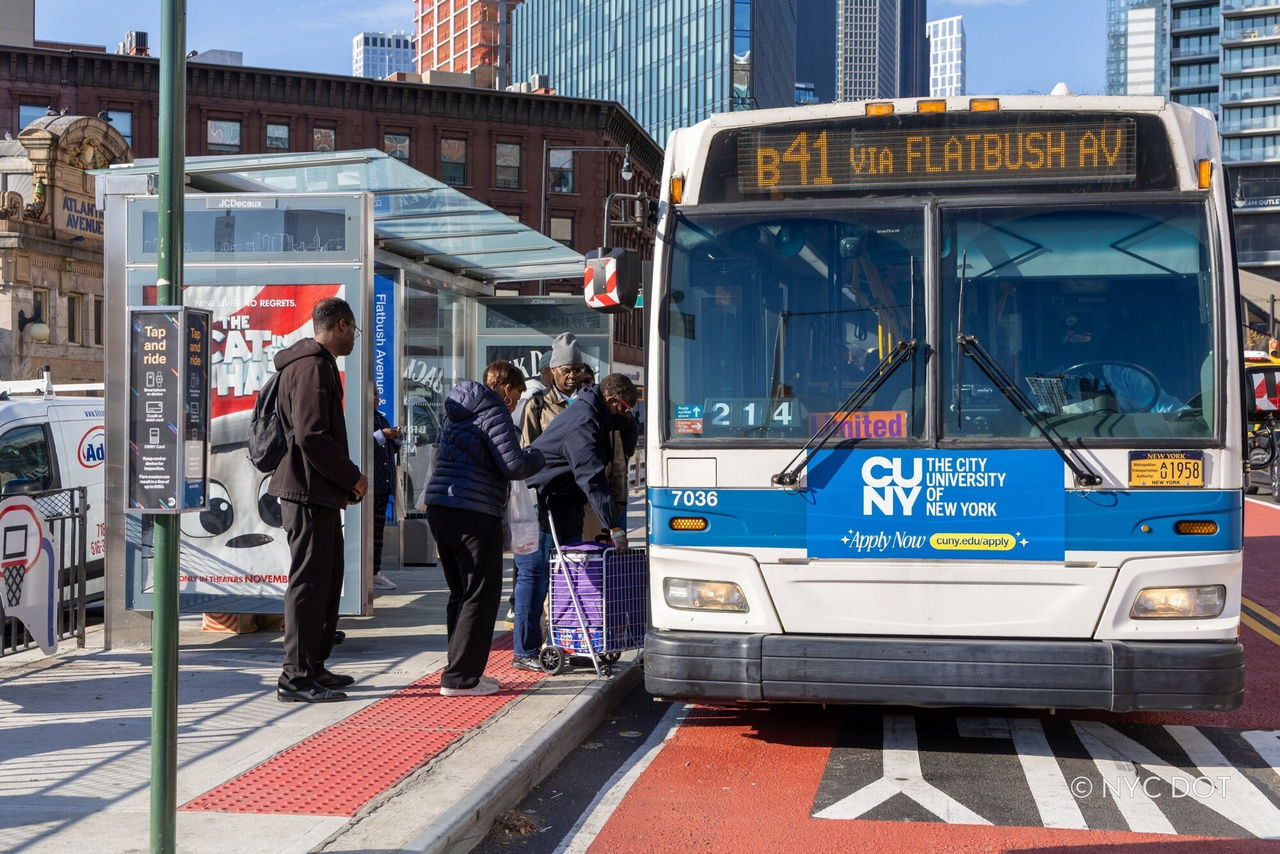
NEW YORK – New York City has completed a major redesign of Flatbush Avenue in Brooklyn, installing barrier-protected, center-running bus lanes along one of the borough’s busiest and slowest transit corridors. City officials describe the project as the first concrete step toward the city’s first true bus rapid transit (BRT) line.
Mayor Zohran Mamdani and NYC Department of Transportation (NYC DOT) Commissioner Mike Flynn announced the completion of the work on Tuesday, November 17. The corridor serves about 120,000 bus riders every day on the B41 – one of Brooklyn’s busiest routes – as well as the B67, B45 and B103. Buses on the avenue have historically crawled along at an average of just 4 mph.
“Flatbush Avenue is the foundation for the future of bus service in New York City,” Mamdani said. “Bus riders are tired of waiting – waiting for the bus that never comes, waiting for the bus to crawl through traffic and waiting for government to care about their precious time. We are changing that.”
What has changed on Flatbush
The redesign adds 1.9 miles of physically protected bus lanes running down the middle of the avenue, along with six concrete bus boarding islands. Every island is equipped with seating, including bus shelters, benches and leaning bars.
Other upgrades include:
- About 29,000 square feet of new pedestrian space, created through the boarding islands and painted curb extensions at intersections;
- 36 new bike racks;
- Roughly 45 new signal poles supporting left- and right-turn signals, Accessible Pedestrian Signals, pedestrian countdown timers and new street lighting;
- Dedicated loading zones and updated parking rules that let commercial and passenger vehicles use metered parking in every parking lane, improving access for deliveries and customers of local businesses;
- New planters maintained by the North Flatbush Avenue Business Improvement District.
According to the city, 69% of households in the communities along the corridor do not own a car.
Flynn said the agency delivered the upgrade “in just a few months” and will spend the coming months monitoring results as New Yorkers adapt to the new traffic patterns, making adjustments where needed.
Bus rapid transit targeted for 2030
City Hall says the redesign lays the groundwork for full bus rapid transit service on Flatbush Avenue by 2030. The project is also a key part of Next Stop: Fast Buses, Better Service, a partnership between Mamdani, Governor Kathy Hochul and the Metropolitan Transportation Authority (MTA) aimed at speeding up 175 routes – nearly 75% of the city’s bus network.
Frank Farrell, Executive Vice President for Buses at MTA New York City Transit, said projects like this one, combined with measures in the MTA’s Bus Action Plan such as expanding automated camera enforcement and purchasing new buses, would make service faster and more reliable.
Public outreach on the corridor began in 2022. This year, NYC DOT also started outreach on the next phase of improvements, covering Flatbush Avenue between Grand Army Plaza and Avenue H.
Art on the boarding islands
The new islands also bring some color to the street. Signs designed by artist Marc-Olivier Lamothe and fabricated by the NYC DOT sign shop feature a series of illustrations titled Day to Day, showing scenes of everyday New York life – from basketball courts and brownstones to bodega cats and greenery. The artwork is mounted on the fences along the boarding islands and will remain on display through fall 2027.
Officials and advocates react
“It’s time to bid farewell to the days of New York City buses moving at a snail’s pace,” said Brooklyn Borough President Antonio Reynoso, who called the separated lanes a major step toward a boroughwide BRT network.
Council Member Shahana Hanif described the project as Brooklyn’s first-ever center-running bus lane and said it would especially help riders who cannot use the city’s many inaccessible subway stations.
Eric McClure, Executive Director of StreetsPAC, said early returns show the design is already delivering faster speeds, while Ben Furnas of Transportation Alternatives pointed to shorter crossing distances and wider pedestrian space as proof that “better buses and safer streets go hand in hand.”
Riders Alliance Executive Director Betsy Plum credited the nurses, teachers, home health aides, students and parents who campaigned for the lanes, adding that the group’s Fix the Bus campaign will keep pushing for faster, free and fully funded bus service across the city.
Part of a citywide push
Flatbush Avenue is one of a series of bus and street safety projects the Mamdani administration has advanced in 2026 across all five boroughs:
- The Bronx: Fordham Road, 161st Street and Tremont Avenue
- Manhattan: 34th Street, 116th Street, 6th Avenue, 9th Avenue, Madison Avenue and Lexington Avenue
- Brooklyn: Marcy Avenue, Flatbush Avenue, Utica Avenue, Church Avenue, Bay Parkway and Cropsey Avenue, Linden Boulevard, and Dekalb and Lafayette avenues
- Staten Island: Victory Boulevard
- Queens: Broadway
Source: NYC Mayor’s Office. Photo: NYC Mayor’s Office.